 84d3adcf2f
The backend is now mature enough to not explode with multiple windows but the `DisplayServer` API still cannot meet some guarantees required by the various Wayland protocols we use. To meet those guarantees this patch adds three new elements to the DisplayServer API, with relative handling logic for `Window` and `Popup` nodes: - `WINDOW_EVENT_FORCE_CLOSE`, which tells a window to *forcefully* close itself and ensure a proper cleanup of its references, as Wayland enforces this behavior; - `WINDOW_FLAG_POPUP_WM_HINT`, which explicitly declares a window as a "popup", as Wayland enforces this distinction and heuristics are not reliable enough; - `FEATURE_SELF_FITTING_WINDOWS`, which signals that the compositor can fit windows to the screen automatically and that nodes should not do that themselves. Given the size of this feature, this patch also includes various `WaylandThread` reworks and fixes including: - Improvements to frame wait logic, with fixes to various stalls and a configurable (through a `#define`) timeout amount; - A proper implementation of `window_can_draw`; - Complete overhaul of pointer and tablet handling. Now everything is always accumulated and handled only on each respective `frame` event. This makes their logic simpler and more robust. - Better handling of pointer leaving and pointer enter/exit event sending; - Keyboard focus tracking; - More solid window references using IDs instead of raw pointers as windows can be deleted at any time; - More aggressive messaging to window nodes to enforce rects imposed by the compositor. |
||
|---|---|---|
| .github | ||
| core | ||
| doc | ||
| drivers | ||
| editor | ||
| main | ||
| misc | ||
| modules | ||
| platform | ||
| scene | ||
| servers | ||
| tests | ||
| thirdparty | ||
| .clang-format | ||
| .clang-tidy | ||
| .clangd | ||
| .editorconfig | ||
| .git-blame-ignore-revs | ||
| .gitattributes | ||
| .gitignore | ||
| .mailmap | ||
| .pre-commit-config.yaml | ||
| AUTHORS.md | ||
| CHANGELOG.md | ||
| CONTRIBUTING.md | ||
| COPYRIGHT.txt | ||
| DONORS.md | ||
| gles3_builders.py | ||
| glsl_builders.py | ||
| godot.manifest | ||
| icon.png | ||
| icon.svg | ||
| icon_outlined.png | ||
| icon_outlined.svg | ||
| LICENSE.txt | ||
| logo.png | ||
| logo.svg | ||
| LOGO_LICENSE.txt | ||
| logo_outlined.png | ||
| logo_outlined.svg | ||
| methods.py | ||
| platform_methods.py | ||
| pyproject.toml | ||
| README.md | ||
| SConstruct | ||
| scu_builders.py | ||
| version.py | ||


Godot Engine

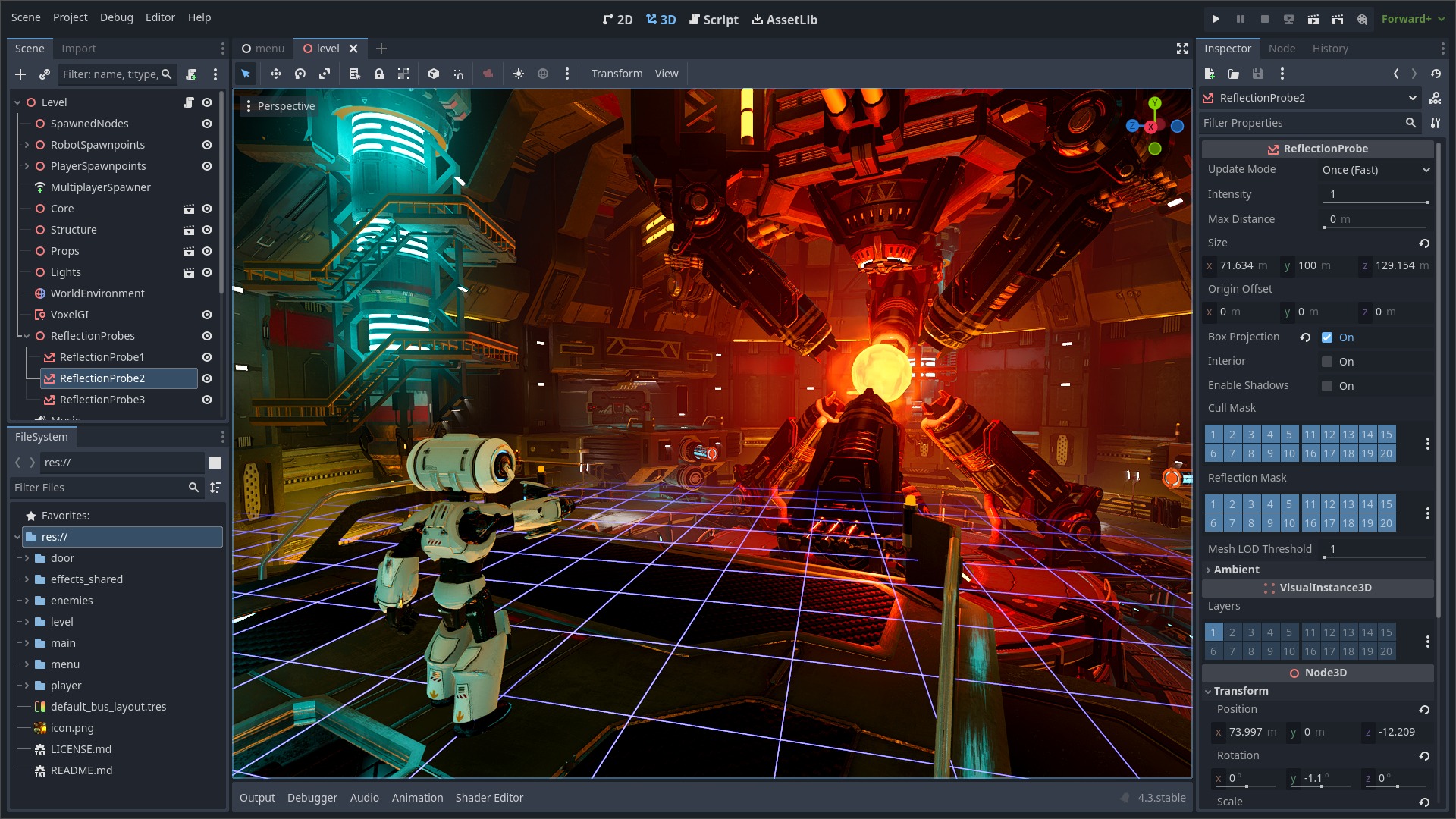
2D and 3D cross-platform game engine
Godot Engine is a feature-packed, cross-platform game engine to create 2D and 3D games from a unified interface. It provides a comprehensive set of common tools, so that users can focus on making games without having to reinvent the wheel. Games can be exported with one click to a number of platforms, including the major desktop platforms (Linux, macOS, Windows), mobile platforms (Android, iOS), as well as Web-based platforms and consoles.
Free, open source and community-driven
Godot is completely free and open source under the very permissive MIT license. No strings attached, no royalties, nothing. The users' games are theirs, down to the last line of engine code. Godot's development is fully independent and community-driven, empowering users to help shape their engine to match their expectations. It is supported by the Godot Foundation not-for-profit.
Before being open sourced in February 2014, Godot had been developed by Juan Linietsky and Ariel Manzur (both still maintaining the project) for several years as an in-house engine, used to publish several work-for-hire titles.
Getting the engine
Binary downloads
Official binaries for the Godot editor and the export templates can be found on the Godot website.
Compiling from source
See the official docs for compilation instructions for every supported platform.
Community and contributing
Godot is not only an engine but an ever-growing community of users and engine developers. The main community channels are listed on the homepage.
The best way to get in touch with the core engine developers is to join the Godot Contributors Chat.
To get started contributing to the project, see the contributing guide. This document also includes guidelines for reporting bugs.
Documentation and demos
The official documentation is hosted on Read the Docs. It is maintained by the Godot community in its own GitHub repository.
The class reference is also accessible from the Godot editor.
We also maintain official demos in their own GitHub repository as well as a list of awesome Godot community resources.
There are also a number of other learning resources provided by the community, such as text and video tutorials, demos, etc. Consult the community channels for more information.

